Showing posts with label 2nd Grade. Show all posts

Jan 25, 2013

People in Motion!

Dancer Series, Charles Searles 1975
     In this lesson, we discuss showing movement and action in artwork.
     The first day, we look at the artwork by Charles Searles. We discuss if they are moving or standing still-the students ALWAYS say moving. Then, we talk about how we know that from looking at a still picture....pattern, rhythm, diagonal lines, etc. Then, of course, we all stand up and practice our poses, some showing movement and some stagnant. I show them how to draw a human using simple shapes and we pick some of the best poses and practice drawing them, first together, then on their own.

      One the second day, we pick their best sketch from the day before and redraw it onto a piece of tag board or manilla file folder. These figures are then cut out.
      Over the next few days, we trace these manilla templates (flipping as we go) to create people in motion-dancers, ninja, skaters, etc. Students were challenged to alternate boy and girl and add LOTS of details.


Oct 19, 2012

Patterned Cats ala Laurel Burch

Get the Lesson
Get the Wall Info.
Get the Parent Note

     I have done this lesson a few different ways. These were done with 1st, 2nd and 3rd grade students (some Montessori mixed-age classes).
     On the first day, we learned about the artist Laurel Burch and students get a sketch paper to practice drawing cats in different positions (I don't give much guidance this day on how to draw cats). On the second day, I teach students how to draw a seated cat step-by-step in the style of Laurel Burch.
     After the cats are drawn, student get to fill the cat in with pattern! We discuss color as they begin painting their cats and they paint the cat in a warm or cool color and then do the opposite for the background (warm cat, cool background or cool cat, warm background).


Sea Turtle Unit


Get the Wall Info.
Get the Parent Note
Sea Turtle Vocabulary Worksheet
Slide Show of Turtle Images


     In this unit, 2nd graders learn all about sea turtles. Students learn to draw sea turtles, we color them with oil pastels and finish with water color and a sprinkle of salt. We talk about how simple shapes can be put together to make more complex ones, like turtles. We also talk about cool colors as we paint in the water around them  because they mix blue and purple or blue and green together (the picture below doesn't show this).


     Then, students get to make a 3-D version with  these clay turtles.They start by making a pinch pot. Then, they pinch out the head, flippers, and tail.We discuss color mixing, tints, and shades as we mix a variety of greens to paint on our turtles.


      We read tons of books and look at videos online throughout this unit. Some of my favorites are:

Carolina's Story: Sea Turtles Get Sick Too!
Follow the Moon
Turtles Tide: the Ways of Sea Turtles


I also Googled a bunch of sea turtle photos and put them into a looping PowerPoint  that students can look at while they work.

Oct 15, 2012

Funky Lizards


     In this lesson, I focused on teaching the types of shape (organic/freeform and geometric) and color (warm and cool). Students started with 2 pieces of paper: 1 one for warm colors and freeform shapes and is the background crayon resist of leaves; the other paper is print with geometric shapes in cool colors for the lizards body
These examples are done by 2nd graders:


Oct 11, 2012

Crazy Hair Day Portraits


     This is a fun lesson to review line and teach portraits. It can be done with any age, but these are done by 2nd graders.
     These are self portraits of our worst hairday!


Oct 8, 2012

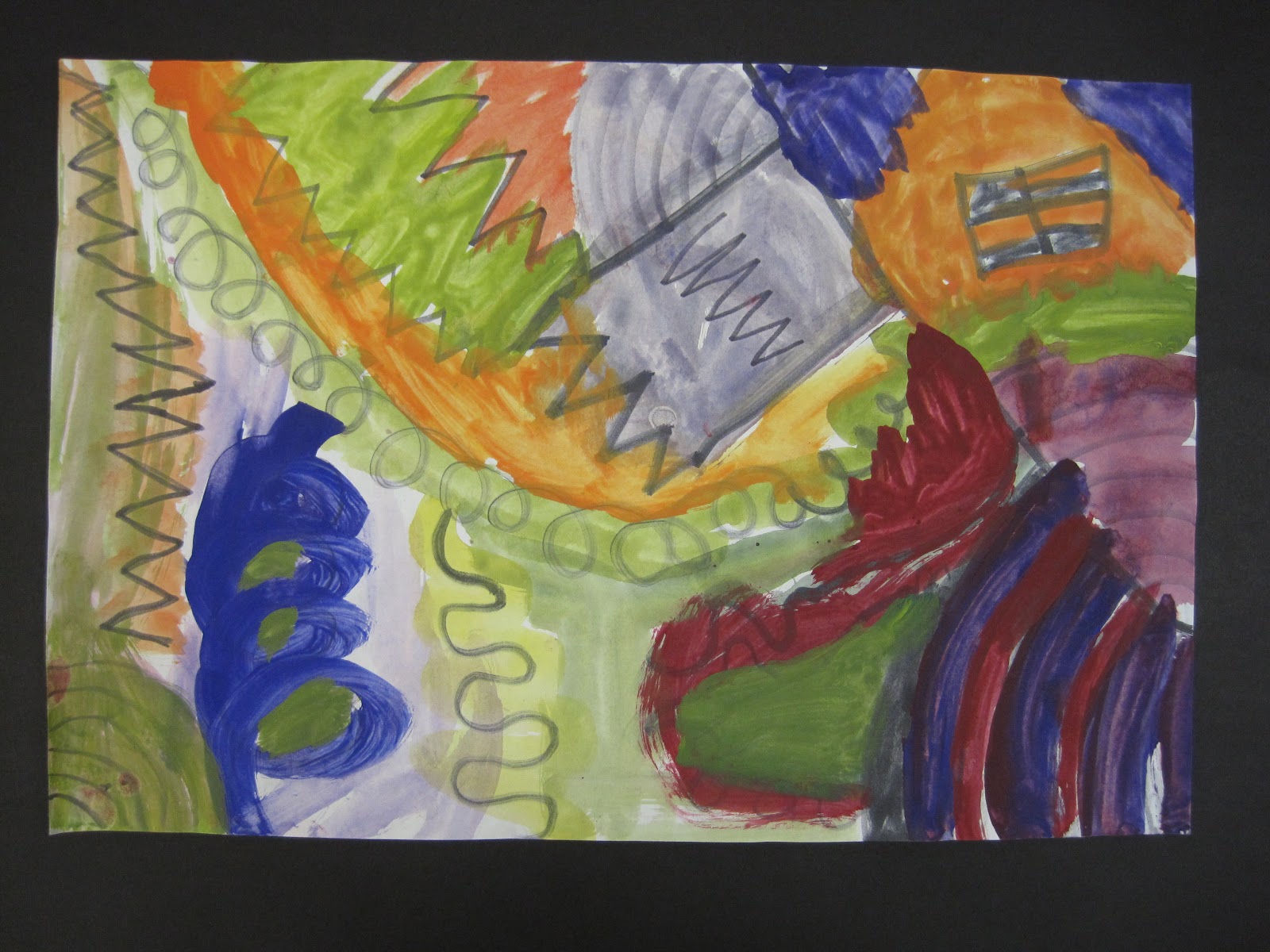
Lines ala Kandinsky

Get the Lesson
Get the Wall Info./ Display
Get the Parent Note

     To begin the school year we review line and color! I do Mondrian with 1st grade to teach primary colors and straight lines.
     In 2nd grade, they review by making a line designs using all the types of line (straight, zig zag, wavy, looped, spiral, and dotted). Then, I give them a palette with just the primary colors and they mix their own secondary colors. They love the color mixing!
 

There are lots of good books lessons on color:

Mouse Paint
White Rabbit's Color Book
Little Blue and Little Yellow
Blue Bug's Book of Colors